
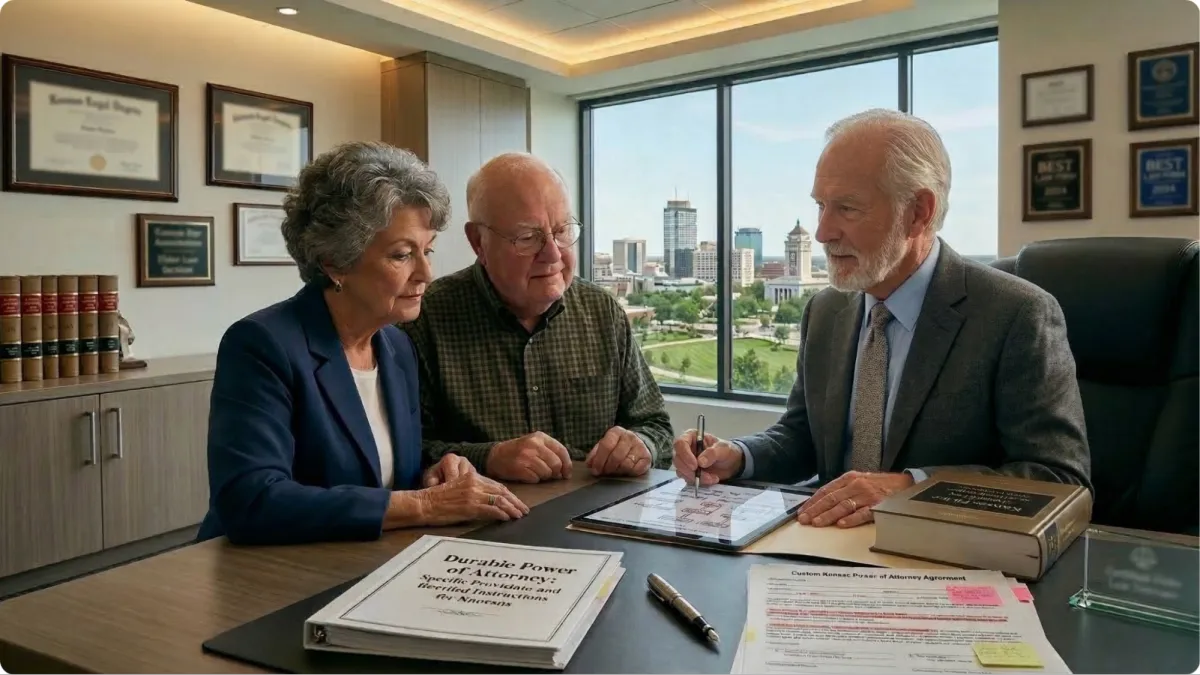
Durable Power of Attorney in Kansas: Why Elder Law Clients Need More Than a Basic Form
Most people know they're supposed to have a power of attorney. Fewer people know whether the one they have will actually work when they need it most.
A power of attorney (POA) is a legal document that lets you name someone — called your agent — to make decisions on your behalf if you become unable to make them yourself. It sounds straightforward. But in the context of elder law, long-term care planning, and Medicaid, the details of that document matter enormously. A basic form — the kind you might find online or receive from a general practitioner — often falls short in ways that only become visible during a crisis.
Here's what Kansas families need to understand about durable powers of attorney, and why this document deserves more attention than it usually gets.
What "Durable" Means — and Why It Matters
Not all powers of attorney are created equal. A standard POA can actually become invalid the moment you become incapacitated — which is exactly when you need it most.
A durable power of attorney includes specific language that keeps the document in effect even if you lose mental capacity. In Kansas, this durability language must appear explicitly in the document. Without it, your agent's authority could be challenged or invalidated at the worst possible time.
This is not a technicality. It's the difference between your family being able to act on your behalf — and having to pursue a costly, time-consuming court process called guardianship or conservatorship just to gain the authority to manage your affairs.
Why Elder Law POAs Are Different from Standard Ones
A basic durable power of attorney might give your agent authority to pay your bills, manage bank accounts, and handle routine financial matters. That's a reasonable starting point.
But for families dealing with aging, long-term care, or Medicaid planning, a standard POA often leaves out critical powers that your agent will need. Some of the most important — and most commonly missing — provisions include:
Medicaid planning authority. Can your agent make gifts or transfers on your behalf to help you qualify for Medicaid? Can they fund a trust? Can they restructure assets in a way that protects your spouse? Without explicit language granting these powers, your agent may be legally blocked from taking the very steps that could protect your estate.
Authority to create or fund a trust. If an irrevocable trust is part of your plan, your agent may need the power to fund it on your behalf if you become incapacitated before it's completed.
Real estate and property authority. Selling, transferring, or managing real property often requires specific POA language that goes beyond a general grant of financial authority.
Healthcare decision authority. A financial POA does not cover medical decisions. Kansas families also need a power of attorney for health care decisions (sometimes called a healthcare proxy or healthcare directive) that names someone to make medical decisions if they cannot speak for themselves. These are two separate documents — and both matter.
For more on how a POA fits into a complete estate plan, see our estate planning overview.
The Medicaid Planning Connection
This is where many families get caught off guard. If a parent develops dementia or has a sudden stroke, the window for proactive Medicaid planning can close quickly. The ability to act fast — to restructure assets, apply for benefits, or implement protective strategies — often depends entirely on whether the power of attorney grants the agent the authority to do those things.
We've seen situations where adult children were ready and willing to help a parent qualify for Medicaid, but the POA their parent signed years ago didn't include the right language. The result: delays, legal fees, and in some cases, assets that couldn't be protected.
The Kansas Medicaid program (KanCare) has specific rules about what financial transactions are allowed and when. An agent acting under a POA must have clear authority to navigate those rules — and that authority has to be written into the document.
What Happens Without a Power of Attorney
If you become incapacitated without a valid POA in place, your family cannot simply step in and manage your affairs. They will need to petition a Kansas court for guardianship (for personal and healthcare decisions) and conservatorship (for financial decisions).
This process is:
Slow — court proceedings take time, even in urgent situations
Expensive — legal fees, court costs, and ongoing reporting requirements add up
Public — unlike a POA, guardianship proceedings are part of the public court record
Stressful — family members may disagree, and the court makes the final call
Inadequate — At times, the things that need to be done in Medicaid planning are prevented by the protectionist stance of the Courts regarding Guardianships and Conservatorships.
A properly drafted durable power of attorney eliminates all of that. It's one of the most cost-effective documents in any elder law plan — and one of the most neglected. For more on how it works alongside other planning tools, visit our elder law and Medicaid planning page.
Don't Assume the Document You Have Is Enough
Many Kansas families have a power of attorney they signed years ago — sometimes decades ago. Even if it was well-drafted at the time, laws change. Circumstances change. The document that made sense when your children were young and your assets were modest may not serve you well now that retirement is here and long-term care is a real possibility.
If you haven't reviewed your POA with an elder law attorney recently, that review is overdue. And if you don't have one at all — or if you're not certain your document includes Medicaid planning authority — the time to address it is now, while you can still make those decisions for yourself.
The U.S. government's LongTermCare.gov has helpful background on why legal planning is a core part of preparing for aging — not a luxury or an afterthought.
Attorney Mark Galloway holds dual LL.M. degrees in Elder Law (University of Kansas) and Tax (Boston University). He has helped hundreds of Kansas families build legal plans that work — not just on paper, but in the real situations families actually face.
Don't wait until a crisis to find out your documents aren't enough. Call Advanced Legal Planning at (316) 252-2233 or schedule a consultation online. Virtual meetings available.